
Most AV Failures Aren’t Technical. They’re Structural.
There is a persistent assumption in live event production that when something breaks, it is usually a technical issue. A piece of gear fails, a signal drops, a cue is missed. It feels immediate and visible, so it becomes the explanation.
But in practice, that is rarely where the problem starts.
What shows up as a technical failure on show day is often the result of something unresolved much earlier. A decision that was left too late. A role that was never clearly defined. A dependency that no one explicitly owned. By the time it surfaces, it looks like chaos. In reality, it has been building quietly beneath the surface.
That is the gap this playbook is designed to close.
The Real Problem: Misalignment, Not Equipment
After working across enough productions, one pattern becomes consistent. The difference between a stressful show and a controlled one is not the level of talent on the team. It is not even the scale of the event.
It is structure.
Teams struggle when:
- Roles are assumed instead of assigned
- Decisions are delayed until they become urgent
- Information is scattered across too many channels
- Dependencies between teams are unclear
- Critical details are discovered too late to fix cleanly
None of these are technical problems. They are structural ones.
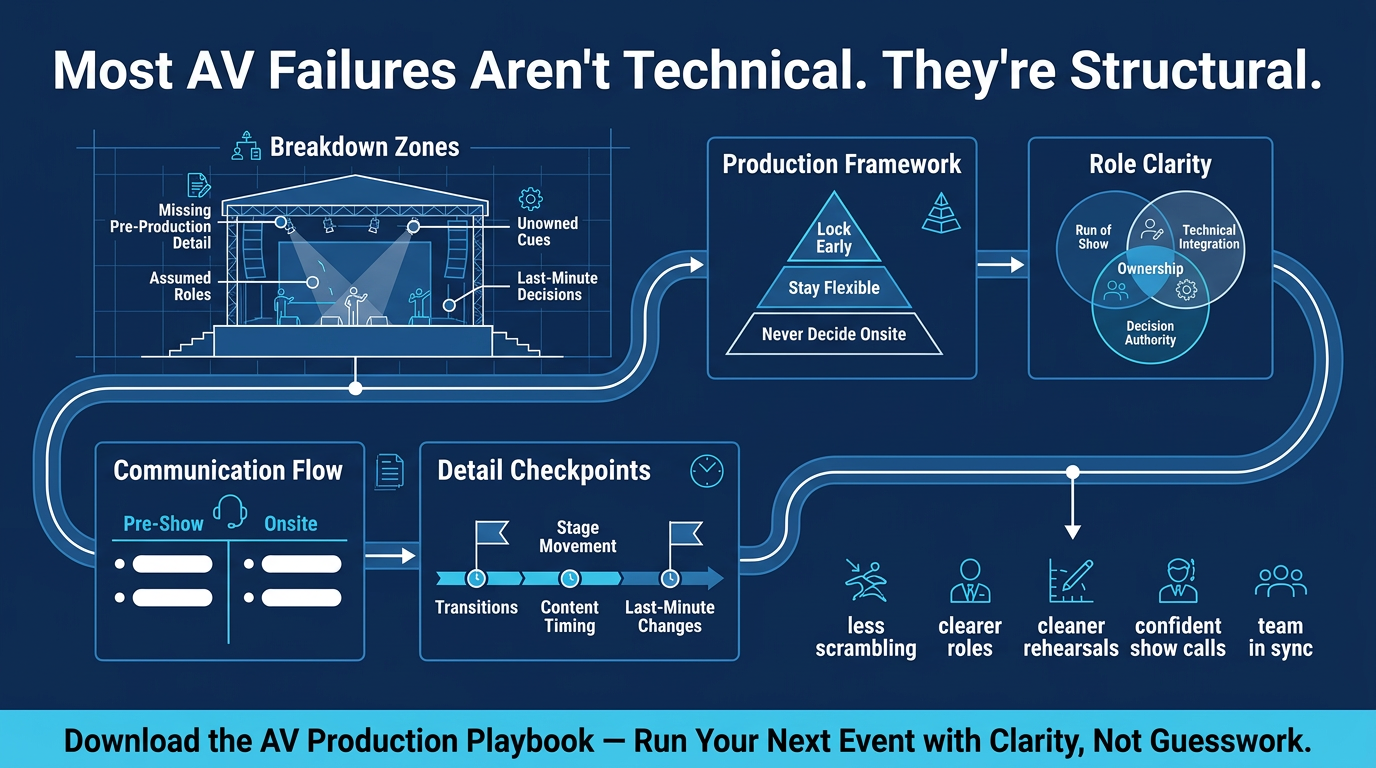
The Shift: Designing the Show Before You Run It
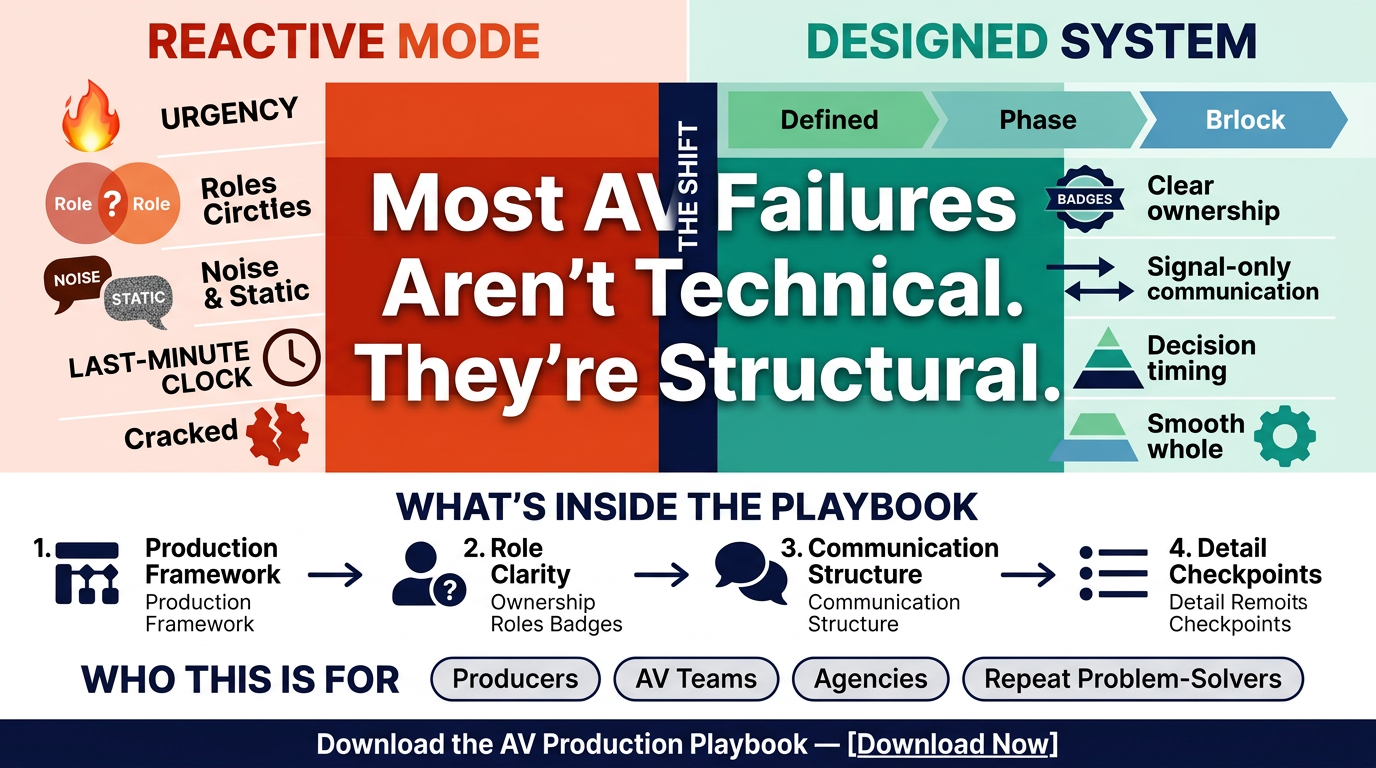
Most teams operate in a reactive rhythm, even when they are experienced. They move quickly, solve problems as they appear, and rely on instinct to carry them through. That approach works, until complexity increases and the margin for error disappears.
This playbook introduces a different approach.
Instead of reacting, you design the operational system of the show in advance. Not just creatively, but structurally.
That means:
- Defining what needs to be locked early versus what can remain flexible
- Establishing clear ownership across every part of the production
- Structuring communication so it holds under pressure
- Identifying risk points before they become real issues
When that system is in place, execution becomes significantly lighter.
What You’ll Find Inside the Playbook
This is not a surface-level checklist. It is a working model for how to run production with clarity.
1. A Clear Production Framework
The playbook breaks the show into phases that go beyond timeline and into decision logic.
You will see:
- What needs to be resolved in pre-production to avoid onsite pressure
- Where flexibility is useful and where it creates risk
- How to prevent last-minute decisions that cascade across teams
This alone removes a large portion of avoidable friction.
2. Role Clarity That Eliminates Gaps
Most production issues trace back to unclear ownership, not lack of skill.
The playbook reframes roles around responsibility:
- Who owns the run of show
- Who owns technical integration
- Who makes decisions when something shifts
- Who is accountable for each critical deliverable
When ownership is explicit, execution accelerates and confusion drops.
3. Communication That Works Under Pressure
Shows do not break when something changes. They break when communication fails.
Inside the playbook:
- How information should flow differently in pre-production vs onsite
- What must be documented versus what must be verbal
- How to structure show calling so cues land cleanly
- How to reduce noise and increase signal across teams
The result is fewer misunderstandings and faster alignment.
4. The Details That Usually Get Missed
Even strong teams overlook small details that create outsized problems later.
The playbook surfaces these early, including:
- Transitions between segments
- Timing alignment between content and staging
- Stage movement and physical flow
- The ripple effect of last-minute changes
These are the pressure points that separate a smooth show from a strained one.
What Changes When You Apply This
The difference is not dramatic at first, but it is immediate.
- Rehearsals become more focused because fewer variables are unresolved
- Conversations become shorter and more precise
- Teams spend less time clarifying and more time executing
- Show flow feels controlled instead of reactive
You are no longer holding the production together. You are running it.
Who This Is For
This playbook is built for people responsible for delivering events where failure is not an option:
- Producers managing complex, multi-stakeholder environments
- AV and technical directors responsible for execution
- Agencies scaling live and experiential work
- Teams that want consistency across events, not reinvention every time
Final Thought
Great events are not held together by effort alone. They are held together by structure.
When the system is clear, the pressure shifts. The team stops chasing problems and starts running a plan.
That is when production feels the way it is supposed to.
Download the AV Production Playbook and start building shows that run the way they were meant to.