
Most teams didn’t adopt AI. They layered it on top of broken work.
AI showed up, and the reaction was predictable.
People opened a chatbot.
Typed a few prompts.
Got faster at doing the same things they were already doing.
And then something strange happened.
They didn’t feel lighter.
They felt busier.
More output. More tabs. More decisions. More noise.
Because AI didn’t remove the work.
It exposed how much of it was never designed properly in the first place.
The shift no one is talking about clearly
Inside companies, expectations are already changing.
No one is impressed that you can “use AI.”
That’s baseline now.
The real shift is this:
You are no longer valued for executing tasks.
You are valued for designing systems that execute without you.
That is a very different skill.
It requires clarity, structure, and the ability to think in workflows instead of steps.
The 4-Layer AI System Model
Most professionals are operating in fragments. A tool here, a prompt there.
What actually works is layering.
Layer 1: Thinking & Understanding (Reduce Cognitive Load)
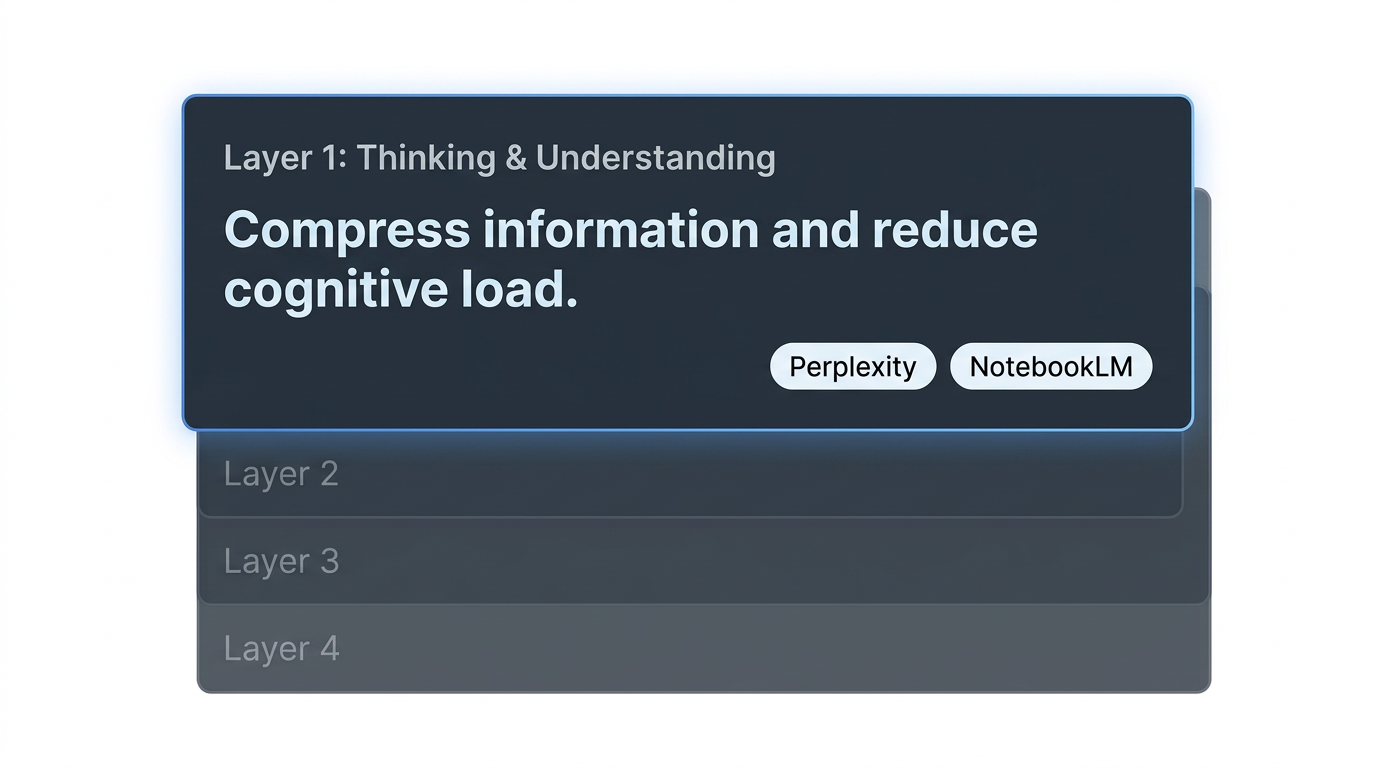 Tools like Perplexity and NotebookLM change how you process information.
Instead of:
- opening 10 tabs
- cross-referencing sources
- second-guessing accuracy
You resolve uncertainty quickly and move forward.
This sounds small. It isn’t.
Most cognitive fatigue in knowledge work comes from incomplete understanding and constant context switching.
When this layer is clean:
- decisions happen faster
- meetings improve
- rework drops
This is not about saving time.
It is about removing friction in thinking.
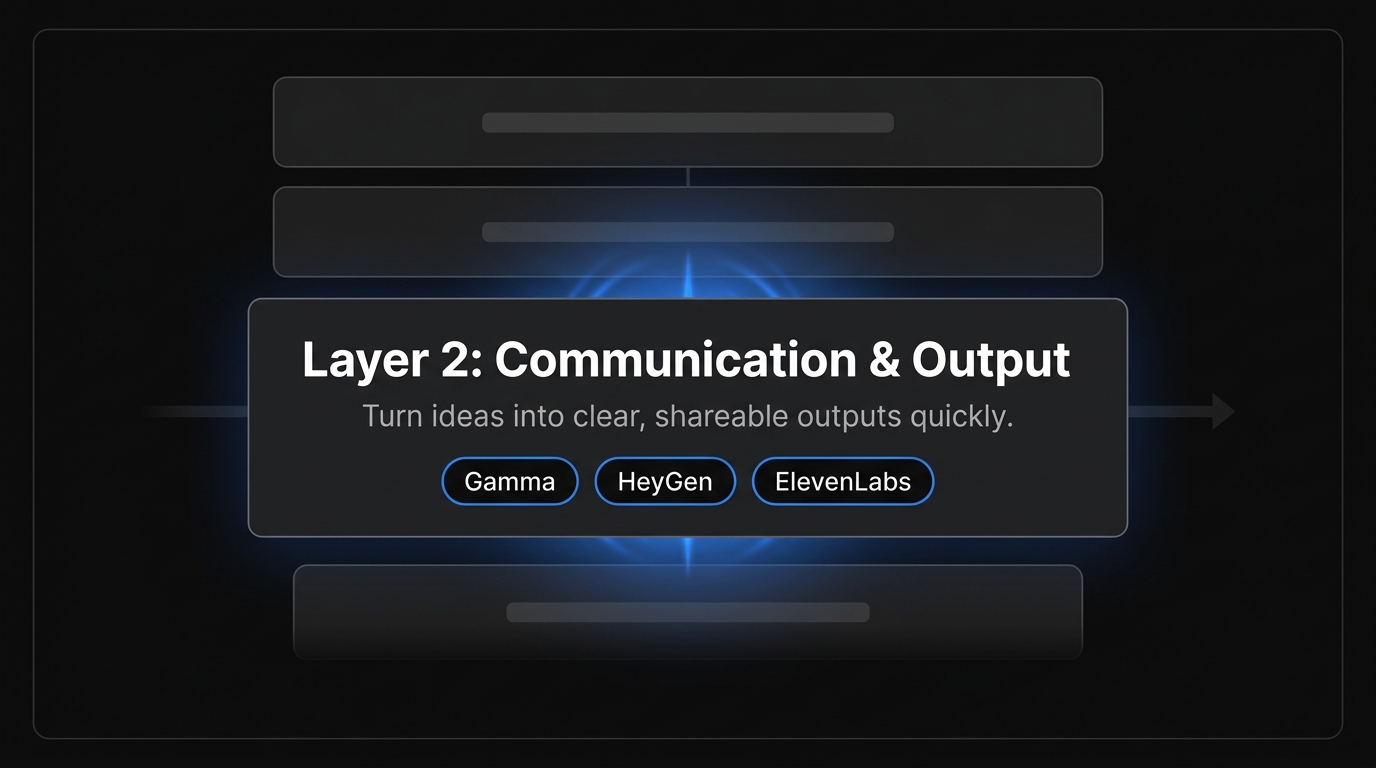
Layer 2: Communication & Output (Move Ideas Faster)
 Most work doesn’t fail because of bad thinking.
It fails because ideas never leave someone’s head clearly.
Tools like Gamma, HeyGen, and ElevenLabs reduce the cost of expression.
You can:
- turn rough notes into structured communication
- explain something once and reuse it
- create content without production overhead
The real shift here is iteration speed.
When communication becomes cheap:
- teams align faster
- feedback loops shorten
- decisions don’t stall waiting for “perfect” output
This is where momentum starts building.
Layer 3: Execution & Automation (Remove Repetitive Decisions)
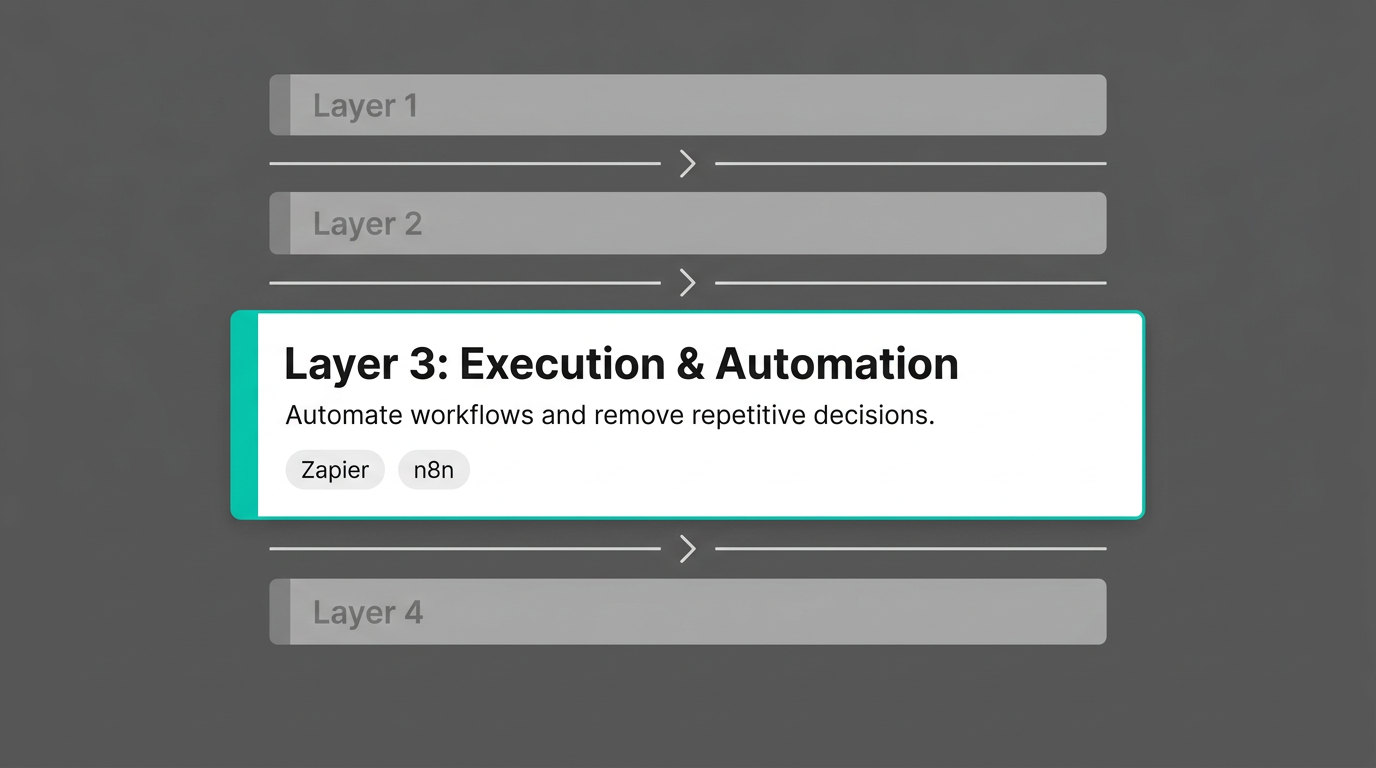 This is where most teams say they are “using AI.”
But they’re usually automating tasks, not workflows.
Tools like Zapier and n8n allow you to connect systems so work moves without supervision.
The real target here is not time savings.
It’s decision elimination.
Every time you check:
- “Did that form come in?”
- “Did someone update the sheet?”
- “Did that email get sent?”
That is a decision loop.
Multiply that across a team, across weeks, across projects.
That’s where energy disappears.
Clean automation removes those loops.
Not partially. Completely.
Layer 4: Delegation & Autonomy (Define Outcomes, Not Steps)
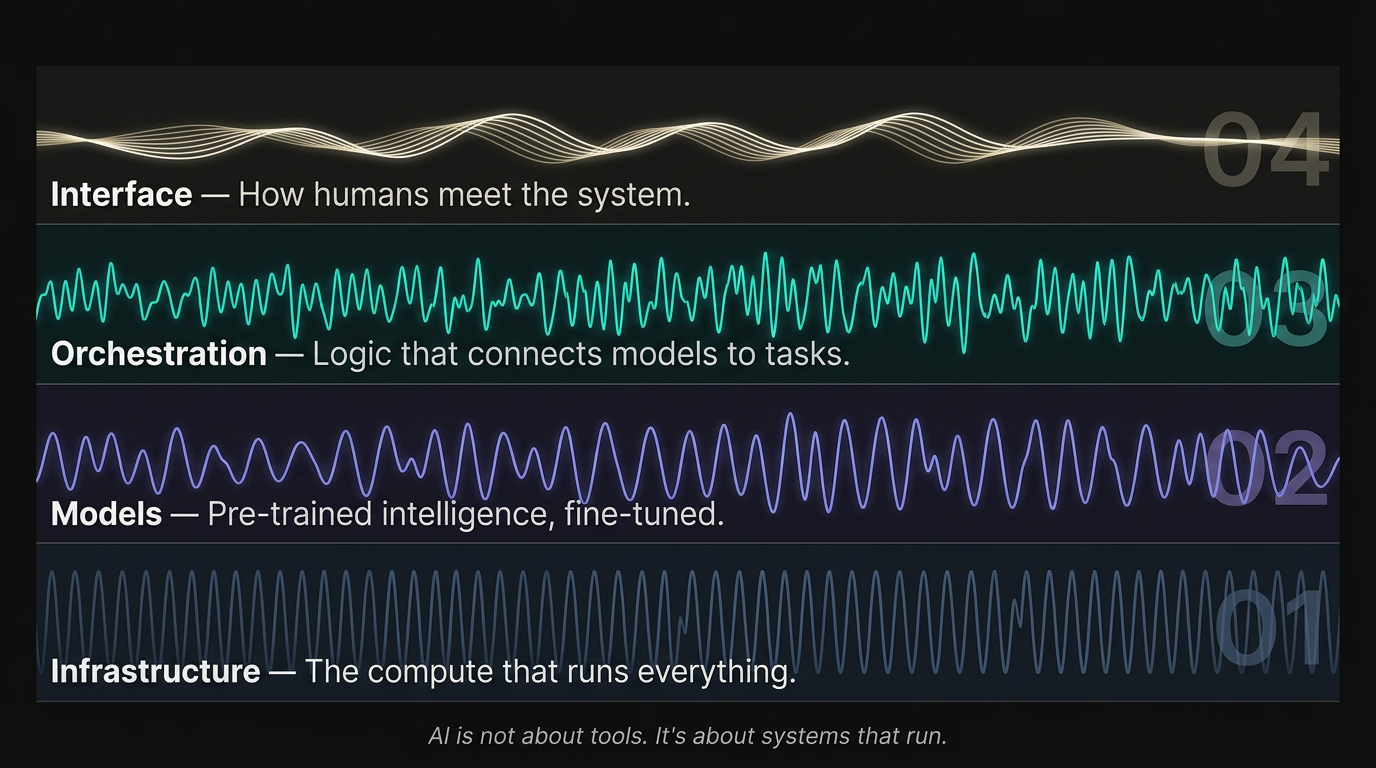 This is where the shift becomes uncomfortable.
Tools like Manus and environments like Cursor move you out of execution entirely.
You don’t:
- research step by step
- compile manually
- format outputs
You define the objective.
The system handles the sequence.
This is closer to managing a junior operator than using a tool.
And it forces a new skill:
Clarity of instruction.
Because vague inputs produce vague outcomes. Fast.
A real example: Event workflow redesign
Let’s ground this in something real.
Old workflow (common in events):
- Search for venue specs
- Download PDFs
- Copy notes into a doc
- Build AV requirements manually
- Create multiple versions of run of show
- Email updates back and forth
It works. But it’s heavy.
Now layer the system:
New workflow:
- All venue docs live in a structured folder
- AI pulls and summarizes specs automatically
- Notebook-style system answers questions from those docs
- Automation routes updates to the right stakeholders
- A system generates first-pass run of show based on inputs
Now the human role shifts to:
- validating
- adjusting
- making decisions
Not rebuilding from scratch every time.
That’s the difference.
Why most AI pilots fail
Not because the tools don’t work.
Because the system underneath doesn’t exist.
Teams:
- add AI to fragmented processes
- keep unclear ownership of decisions
- rely on individuals instead of workflows
So output increases, but coordination gets worse.
This is where burnout actually increases with AI adoption.
More speed. Same chaos.
What actually works
Teams that get value from AI do three things differently:
1. They map the workflow before adding AI
Where does work start, move, stall, and finish?
2. They remove unnecessary decisions
If a human has to check something repeatedly, that’s a design problem.
3. They assign outcomes, not tasks
“Build this report” instead of “pull this data, format this, send this.”
That shift alone changes everything.
Where this is going
The next advantage is not tool knowledge.
It is operational design.
One person, multiple systems, continuous execution.
Less context switching.
Less cognitive overload.
More clarity, more control.
And here’s the part most people don’t like:
AI doesn’t make you better automatically.
It makes your current way of working visible.
Clean systems scale.
Messy systems collapse faster.
Final thought
If you feel busier after adopting AI, you didn’t do it wrong.
You just stopped hiding the friction.
Now you have a choice:
Keep layering tools on top of it.
Or redesign how the work actually flows.
Only one of those scales.
Most event teams are not behind on AI. They are experimenting with it constantly.
The problem is that experimenting is not the same as benefiting from it. And the data is pretty direct about this: 91% of event professionals are using AI in some capacity. Only 15% are doing it strategically.
I built a free guide that shows you the difference, with the numbers to back it up.
It is called the AI for Event Planners 2026 Implementation Guide, and it covers the full picture: where AI is ready and underused, where adoption is stalling, and the framework for building systems that actually compound.
Free. No catch. Just your email.
Work With Me
Many organizations experimenting with AI quickly discover that tools alone are not enough. Real value emerges when AI is integrated into workflows, decision systems, and operational processes. If your team is exploring how to move from AI experimentation to structured implementation, I work with organizations through strategy sessions, workshops, and advisory engagements focused on practical adoption. The tools will continue evolving. The organizations that benefit most will be those that design the systems around them. You can schedule a conversation here.